Based in South Croydon Nothing charged for coming to look 10 year written guarantee

Common Roof Problems In Croydon

Can you work out what you are looking at before you ring anyone?

The eight faults that account for most of the roof work in this borough, and how much of a hurry to be in about each

Nobody expects a homeowner to diagnose their own roof, and that is what a free survey is for. But there is a real difference between ringing somebody knowing nothing and ringing them with a reasonable idea of what is going on, not least because it makes it much harder for anybody to talk you into work you do not need. What follows is what turns up most often on Croydon roofs, in plain terms. Two of them - condensation and guttering - between them account for a large share of the call-outs where the roof itself turns out to be fine.

Not sure? Get somebody to look

Four details and somebody will come and look at it. There is no charge for the visit, no obligation afterwards, and if the answer is that your roof is fine, that is what you will be told.

1,000+

Roofs put right

10 year

Written workmanship guarantee

£0

To have somebody come and look

Repair first

Replacement is the last resort

Eight things that go wrong, and what they mean

01A slate or tile has slipped

Weeks, not months
What it looks like
One visible gap or a tile sitting at an angle, often near a verge, a hip or the edge of the slope.
What is actually happening
On older Croydon terraces this is usually nail fatigue: the fixings have corroded and the slate is being held by friction rather than by anything. On the interwar stock further south it is more often wind that got under an edge.
Why it matters
The gap exposes the felt to sunlight, which degrades it, and it gives the next gale an edge to lift. One tile becomes a course surprisingly quickly. The repair itself is small and cheap if it is caught early.

02A damp patch on an upstairs ceiling

Get it looked at
What it looks like
A brown-edged stain, sometimes with the paint blistering around it. May only appear after certain kinds of weather.
What is actually happening
Water is coming in somewhere and travelling before it drops. The entry point is very often several metres away from the stain, following a rafter or a batten until something interrupts it.
Why it matters
It will not dry out on its own and prolonged wetting rots timber. Worth knowing: if the patch grows steadily in dry weather as well as wet, it is more likely condensation than a leak, and that is a ventilation problem rather than a roofing one.

03Water running down an inside wall in heavy rain

This one is usually cheap
What it looks like
Wet appearing high on an outside wall during downpours, drying between them. Often a green or black stripe on the outside of the wall in the same place.
What is actually happening
Almost always guttering. Either it is blocked, or the brackets have sagged so the gutter no longer falls towards the outlet and water sits in the middle and goes over the front.
Why it matters
It is one of the cheapest things on this list to put right and one of the most expensive to ignore, because months of water down a wall softens pointing and eventually gets through to the plaster inside.

04Ridge or hip tiles out of line

Before the next gale
What it looks like
The line along the top of the roof, or down a hip, is no longer straight. You may see mortar missing between the tiles.
What is actually happening
The mortar bedding has failed. This is the single most common storm casualty on the interwar semis across Shirley, Selsdon, Coulsdon and Sanderstead, and it is usually age rather than the storm.
Why it matters
A loose ridge tile falling from that height is genuinely dangerous, and a whole ridge line can go in one night once the first one moves. Rebedding a ridge is a day's work.

05Damp on a chimney breast

Get it looked at
What it looks like
Staining on the chimney breast in an upstairs room or the loft, sometimes with a white powdery bloom on the brickwork.
What is actually happening
Water getting into the stack, usually through cracked flaunching at the very top or through open pointing, and running down inside it. Less often it is the flashing where the stack meets the roof.
Why it matters
A saturated stack takes a long time to dry and the salts it carries out damage plaster. Disused stacks are the worst offenders, because there is no warm flue drying them from inside.

06A puddle sitting on a flat roof

Plan for it
What it looks like
Standing water still there two or more days after rain, often with a tide mark around it.
What is actually happening
The deck was never laid to enough of a fall, or it has sagged between joists. The covering is not the fault, though it will become one.
Why it matters
Nothing survives being permanently submerged. Recovering the roof without correcting the fall just resets the clock on the same failure, which is why anybody who quotes without mentioning the falls has not looked properly.

07Moss across the roof

Rarely urgent
What it looks like
Green or grey growth, thickest on north-facing slopes and under overhanging trees.
What is actually happening
Shade and damp. Croydon has heavy tree cover across Shirley, Selsdon, Purley and West Wickham, plus around 33,000 council street trees, so shaded slopes are common here.
Why it matters
Less than people are told. Moss itself rarely causes leaks. What it does do is shed into gutters and block them, and it holds moisture against the covering. Worth clearing, not worth panicking about, and be wary of anyone who leads with it.

08Condensation in the loft

Worth correcting
What it looks like
Water beading on the underside of the felt or on the nail points, black spotting on the timbers, damp insulation at the edges. Worst on cold mornings.
What is actually happening
Air cannot move through the roof space. Very often the eaves ventilation was closed off when uPVC soffits were fitted over the original timber without vents.
Why it matters
It is regularly mistaken for a leak, and sealing the roof up tighter makes it worse rather than better. Correcting the ventilation is straightforward and does not need the roof covering touched.
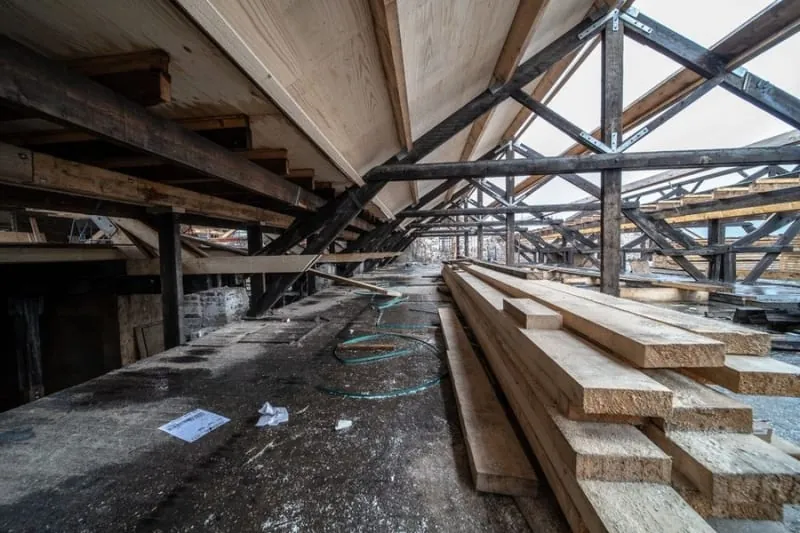
Roof timbers seen from inside a loft during a survey in Croydon

What you can safely check yourself

Do not get on the roof. More people are hurt inspecting a roof than are hurt by one, and a roof that has just lost tiles has loose material on it. Everything worth knowing can be established from the ground, from an upstairs window and from inside the loft.

  • From the pavement, with binoculars. Look along the ridge and the hips for a line that is no longer straight, and along the verges for anything lifted or missing. Photograph anything odd.
  • In the loft, on a bright day, lights off. Daylight where there should not be any tells you where the covering is open. Look at the nail points and the underside of the felt for beads of water.
  • In the loft, during rain. The single most useful five minutes available to you. You can often see exactly where water is entering and which way it runs.
  • Outside walls, after a downpour. Green or black vertical stripes mean the gutter above has been overflowing at that point for a long time.

"The two most common things we are called out to in Croydon and find nothing wrong with are moss and old-looking tiles. Neither is a reason on its own to spend money."

Based on the surveys carried out by Roof Repairs Croydon

Questions about roof problems

How do I tell a leak from condensation?

A leak follows the weather - it appears during or shortly after rain and it has a defined edge. Condensation is more general, worst on cold still mornings, often shows as beads of water on nail points and on the underside of the felt rather than a running trickle, and it turns up alongside black mould spotting on the timbers. If the damp gets worse in a cold dry spell, it is not a leak.

Is moss on my roof actually a problem?

Usually much less than you will be told by anybody knocking on your door about it. Moss does not generally cause leaks. It sheds into gutters and blocks them, and on a shaded slope it keeps the covering damp, both of which are worth dealing with. But moss on its own is not a reason to replace a roof, and a firm that leads with your moss is selling something.

Should I get my roof cleaned or pressure washed?

Be careful. High pressure washing strips the surface finish off concrete tiles and can drive water up under laps, and on older slate it loosens fixings. Clearing moss by hand and treating the roof is a gentler approach. Anybody proposing to jet-wash a Victorian slate roof should be turned down.

My neighbour's roof is causing my damp. What can I do?

This comes up constantly on the terraces in the north of the borough, where gutters and party walls are shared. The first useful step is establishing where the water is physically getting in, which is what a survey does, because an informed conversation with a neighbour goes very differently to a suspicious one. If it does turn out to be their side, you have something concrete to show them.

How often should a roof be checked?

Every couple of years is plenty for most houses, plus a look after any serious gale. Gutters want doing annually, and twice a year on the heavily wooded roads in Shirley, Selsdon, Purley and West Wickham. There is no need for anything more elaborate than that on a sound roof.

Somebody knocked on my door and said my roof needs work. Should I believe them?

Treat it with real suspicion, particularly after a storm. Reputable roofers in this borough are busy enough without cold-calling, and doorstep roofing is a well-established route to being badly overcharged for work that was not needed. Get an independent opinion before agreeing to anything, do not pay up front, and never let anyone start the same day.

Straight to the relevant page: Leak repairs · Guttering · Chimney repairs · Flat roofs

What Croydon homeowners say

From roads across the borough, once the ladders had gone.

"Damp patch on our landing ceiling for about three years. Two roofers had been out and both mended the tiles directly above it, and neither made the slightest difference. This chap spent twenty minutes in the loft with a torch before he even went outside, then showed me a photo of a split in the lead in the valley about four metres away from the stain. Fixed it in a morning. Three winters on and nothing."
Ruth K. - Sanderstead
"Water was coming down the front bedroom wall every time it rained hard and I had convinced myself the roof was finished. It was the gutter. Half of it had dropped so the water was sitting in the middle and going over the front rather than down the pipe. He reset the brackets and cleared the gully, charged me a fraction of what I had budgeted for, and told me the roof itself had years left. Could easily have sold me a new one."
Danny O. - Thornton Heath
"Ours is in the Chatsworth Road conservation area and I had no idea the rules on roof work here are stricter than the rest of Croydon. He knew straight away, explained what I could and could not do without an application, and did the repair in matching slate. That saved me a very awkward conversation with the council later on."
Marianne P. - Addiscombe
"Lost most of the ridge tiles along the back in a February gale. Rang in the morning, sheeted the same afternoon so the weather could not get in, came back the following week when it was dry and rebedded the whole ridge properly. Sent me photos of everything for the insurance without me even asking. The bill was exactly what the quote said it would be."
Steve H. - Coulsdon
"Gutters had been overflowing under the trees for years and the fascia behind them had gone soft. What I appreciated was that he explained why the timber had rotted rather than just quoting to replace it, and pointed out the new soffits needed vents or I would end up with condensation in the loft instead. Nobody had ever mentioned that to me before."
Angela T. - Shirley

Had us out to your roof?

Two minutes writing a review does more for a small local firm than any amount of advertising, and it helps the next person in Croydon work out who to ring.

Still not sure what you have got?

That is entirely normal, and it is exactly what a free survey is for. Somebody comes out, goes up, looks in the loft and tells you what has actually gone wrong. No charge for the visit, no obligation afterwards, and a genuine willingness to tell you that nothing needs doing.